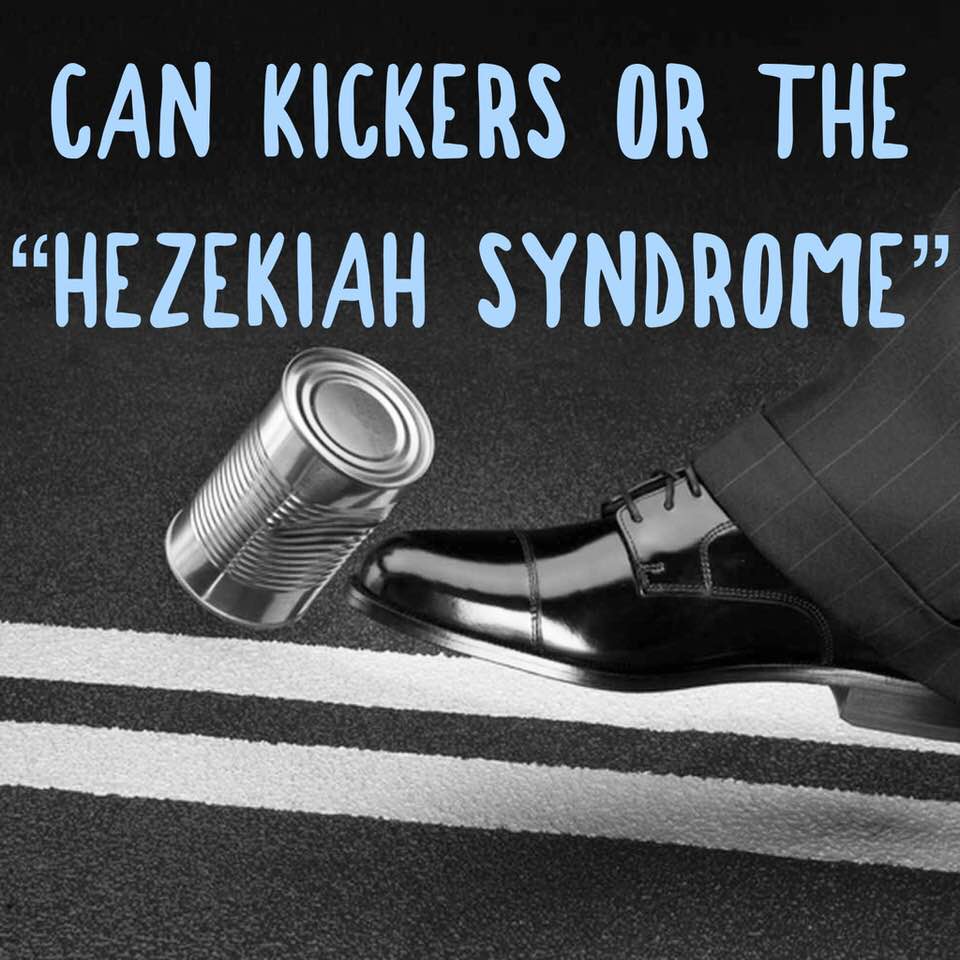
 It’s commonly referred to as “kicking the can down the road.” This is when a leader refuses to deal with an issue that will have negative ramifications – later. The idea is, as long as I am gone when everything hits the fan, I’m good with that.
One of the most notorious cases of “can kicking” happened a few thousand years ago. The Bible tells the story of King Hezekiah who foolishly showed off all of the national treasures to visitors from a distant land. Isaiah (who was a prophet) addressed the trouble that would come as a result of Hezekiah’s mistake:
Then Isaiah spoke to Hezekiah, “Listen to what God has to say about this: The day is coming when everything you own and everything your ancestors have passed down to you, right down to the last cup and saucer, will be cleaned out of here—plundered and packed off to Babylon. God’s word! Worse yet, your sons, the progeny of sons you’ve begotten, will end up as eunuchs in the palace of the king of Babylon.”19 Hezekiah said to Isaiah, “If God says it, it must be good.” But he was thinking to himself, “It won’t happen during my lifetime—I’ll enjoy peace and security as long as I live.” (II Kings 20:16-19 MSG)
This is a little shocking. How, in good conscience can a king show such disregard for his family and descendants?
Take another look: Hezekiah said to Isaiah, “If God says it, it must be good.” But he was thinking to himself, “It won’t happen during my lifetime—I’ll enjoy peace and security as long as I live.” In other words, I really don’t care about what happens to people in the future – I’m OK.
Prototypical “kicking the can down the road!”
In a nutshell, here is the root of the Hezekiah syndrome:
Selfishness: when leaders care more about their wellbeing than that of those they lead, the phenomenon occurs.
Shortsightedness: when leaders can’t anticipate the long-term results of their decisions, those in the future may suffer.
When leaders don’t care about those who will come behind them, careless and even cruel decisions can be made.
When leaders are too weak to make decisions that are good for their progeny, the Hezekiah syndrome will reveal itself.
And this last “root” is worth focusing upon.
It is possible that leaders in 2018 may make decisions (or refuse to make decisions) that will hurt their children, grandchildren and many generations to come. If I am hurting the future by ignoring an issue today, shame on me.
If you are a leader and you observe a problem that may hurt others down the road, and if you have the capacity to address that problem, it would be a dereliction of duty to let it go. True, the results may not come about on your watch but it is immoral to be able to prevent future pain and not do so.
Leaders, our children need us to be strong. Our grandkids are counting on us having a backbone. If we see a problem that is fixable, fix it!
Now, apply the principles of the Hezekiah syndrome to your family, your business, your church, your community, your country… Your descendants will thank you!



 Thoughts on Life and Leading