I Found Myself Numb

images-133

I heard myself saying the right things but I felt myself feeling nothing. As we were at the bedside of a yet another dying person, I was disturbed, not at the idea of death or even the mourning of a family but that I had grown so accustomed to the scene. This was after many years of pastoring. Too many funerals, too many emergency room visits, too many death-bed experiences. I had become the pale-faced, cold-blooded undertaker we’ve all seen on old westerns – except that I was supposed to be a pastor. It wasn’t that I didn’t care; I really did and was hurting for the family. It was simply a matter of overexposure and lack dealing with grief properly.

I didn’t get numb overnight. Unfortunately, I’ve had more than my share of morbid experiences: Identifying bodies burned in a house fire; gruesome deaths of children; and having to do things in hospitals that nurses didn’t want to do and family members couldn’t bring themselves to do. The breaking point seemed to be the slow and agonizing death of a young friend. I stood helplessly by his side for months and watched as his wife and young son let him go. I helped the undertaker load his lifeless body on the gurney.

I had allowed a shell to build up around my heart. For years, while conducting funerals, I have heard remarks like, “I don’t know how you held it together.” But this was different – this wasn’t composure.

I got my wake up call before it was too late. When I realized I wasn’t experiencing the proper response to death, I knew something had to change. I have since made necessary adjustments. These changes are too personal to share but they were precise and effective.

So how does one in my profession avoid becoming cold-blooded? My few suggestions would be:

Allow yourself to grieve (possibly in private because your breaking down in public could cause a tidal-wave response).

Be sure to debrief after especially difficult experiences.

Seek counsel when the load is heavy. Even those in the helps industries need help.

Pray that God will keep your heart tender. See Ezekiel 36:26.

I don’t regret my life work. In fact, I treasure it and am honored to be called by God to do this work. But I would like to avoid this pitfall in the future and help others to also avoid it.

Don’t let yourself become numb.

Deciding Controversial Issues

controversy1

Big decisions are being made right now. Many people are strongly opinionated about some current issues. Lines are being drawn.

But I wonder how most people arrived at their conclusion.

If you will allow me, I will humbly make some suggestions for anyone who is considering which side of the fence they are on regarding the issues in the news.

Don’t allow the media to influence you. They have an agenda. And they have no interest in your best interest.

Don’t trust the political parties. Once again, they merely use the citizens to get what they want.

Don’t form your opinions based on social media. Most people who voice their positions there have not studied the issues.

Don’t be influenced by celebrities. I heard a quote the other day: “What happens in Hollywood doesn’t stay in Hollywood.” While I wish that were not true, it is. Without being too harsh, we don’t need a bunch of dysfunctional rock stars directing our lives.

Don’t go by polls or popular opinions. These change with the wind.

Don’t make your decisions based on your emotions. These also are subject to change.

Don’t side with what seems right. Like it or not, we are sometimes easily deceived.

Don’t even base your opinions based solely upon the church because the church is made up of imperfect people.

So, where do we go to get the correct guidance when we are making our decisions about controversial topics?

I bet you saw this coming: Go to the Bible. And here is why:

The Bible is here to stay. It has withstood the test of time. It has survived all the scrutiny. It will not change. It takes no regard for what is popular or trendy. It is not influenced by popular vote. It is not even concerned with hurting people’s feelings. It simply is the truth. The reason it is the truth is that is it authored by God. He is the only One who never changes. What He says has always worked and it always will work.

A really good reminder about this is found in Matthew 24:35 “Heaven and earth will pass away, but My words will by no means pass away.”

Whether it is gay marriage or abortion or the economy, you just can’t go wrong siding with God. He has never been wrong, and never will be.

Don’t Blame Me, I’m Just the Leader

don't shoot me

Hey leaders, when something goes down within your organization, don’t let people blame you.

Step up and blame yourself!

That’s right. Leaders don’t run from blame and they certainly don’t blame other people. Leaders accept the responsibility for the need for change and they lead it! That’s what leaders do.

Leadership guru John Maxwell says, “Everything rises and falls on leadership.”  There have been times in my career that I have hated that adage. When things are going poorly and the team is not producing, I want to point at someone else and take the pressure off of myself. But it’s my job to lead the team into success. With certain qualifiers, as goes the leader, so goes the team. There will be times when someone else messes up. As the leader, we must be strong enough to shoulder the blame and do what it takes to correct the direction.

I heard a ministries consultant take another angle: If you’ve been at your current appointment for at least 3 years, you own every problem. You can no longer place the blame on your predecessor.  You’ve been there long enough to address it. As the current leader, it’s your duty to deal with it and fix it. We can’t exonerate ourselves from it or abdicate our responsibility.

Let’s use Jesus as our example:

In John 18:10, Simon Peter cut off the ear of Malchus. Jesus rebuked Simon and healed the guy’s ear! He explained that His kingdom was not one of violence.

In Matthew 17:24-27 Peter commits Jesus to paying taxes without consulting Jesus. Again, Jesus fixes the problem.

In Mark 9:14-29, Jesus’ disciples failed to remove a demon spirit from a boy. Jesus took care of the issue and set the boy free.

Notice something – not only did Jesus accept responsibility and fix the problems, He also showed His disciples how to prevent the problems from being repeated. He utilized them in the solution, training them for the future.

I love that! Real leaders are willing to meet a challenge head-on. They do whatever it takes to correct the crisis. They utilize the problem to train their team. And as a result, the team grows in its abilities.

So once again, when something breaks in the organization, don’t find someone else to blame. Just lead the change. That’s what leaders do.

Why It’s Good to be the Minority Sometimes

539244_836055790996_937900356_n

When you are the only one in the crowd who looks like you and talks like you, it’s a strange feeling. But it’s a valuable experience for us know what it is like to be really different from everyone else.

This happens occasionally on missions trip. I have had a few experiences where I was alone in a foreign country; I didn’t speak the language and I couldn’t read the signs. This happened to me both in Haiti and in Indonesia. Talk about feeling vulnerable! I tried to make myself as unnoticeable as possible. I didn’t want to bring attention to myself. No eye contact, look confident and brave, try to look tough so as to discourage any would-be thugs looking for an easy mark. And once those experiences were over, it was a huge relief to get back with a more familiar crowd – where I was like everyone else.

The picture above is my 2 year-old granddaughter, Sophia. She is being raised in Central America where her parents direct an orphanage (casashalom.net).  She is the only white child among 70. Blonde hair and blues eyes really stand out. If her family remains there, she will be raised as a member of the minority culture. While she will certainly face challenges because of this, she will grow up with a unique perspective on life.

The more of a minority you are, the more you feel out of place. Well, you are out of place – that’s the point! Stuff happens in your heart when it is painfully obvious that you are not like everyone else.

I think that there is tremendous value in, from time to time, being in the minority:

  • You learn compassion and empathy for people who live this way. Many people spend their entire lives as a minority. They can never truly relax. They are always being profiled. Now you know a little bit about how they feel – there is value in that.
  • You increase your awareness of and sensitivity to the culture around you. You watch others and try to behave as they do. Becoming a part of the people takes top priority. This is a valuable skill for missionaries.  The Apostle Paul discusses this in I Corinthians 9:19-23.
  • You walk carefully, not wanting to offend someone or create a cultural faux pas. One unintentionally rude mannerism can get you into big trouble.  You grow in your ability to relate to other cultures.
  • Your vulnerability keeps your ego in check. It’s hard to be arrogant when everyone thinks you are strange.
  • You learn to appreciate your familiar surroundings. Once you get back home, you can feel the security of your safe zone, and it feels nice.

I believe this also relates to our lives as Christ-followers on this earth. The Bible tells us that we are aliens; we are not citizens of this world (John 17:14, Philippians 3:20, I Peter 2:11).  We must remember that we are out of place here. Let’s not get too comfortable. Let’s not let down our guard. Let’s walk carefully. Remember, we are the minority.

Go for it. Take a trip or put yourself in a situation where you are the one who is different. Be deliberate about it. I think it will change your perspective.

The Pressure is Good for You

images-123Who am I trying to kid? Stress kills, we all know it. Heart disease and addictions and insomnia – with results like these, it’s not sounding all that healthy now, is it?

Zero in on this: When managed properly, pressure makes us produce. Whether the squeeze is a quota to meet at work, a relationship to mend or a temptation to whip, the expectation that we will do well increases the likelihood that we will do well.  It’s in the nature of most of us to want to succeed at the things we try. Those who avoid pressure in all forms are trapped in a rut of intimidation. We need a little pressure to squeeze us out of these ruts.

There are some keys to keeping pressure healthy and to managing the amount of stress that works for our good.

Know how much is enough. You have to be aware of your trigger points. What are the signs that it is getting to you? Just this side of that, back off.

Be in control of it. Never let the pressure control your life. You call the shots, you be the boss of the pressure, not the other way around.

Take a break. Even non-geniuses know you need to vacate sometimes. A daily 20-minute power nap may do the trick or you might need a cruise from time to time. All work and no play makes Jack act like an idiot.

Share the load. One guy can do the work of two but two can do the work of five. Synergy is the principle at work here. Learn the skill of teaming up. The pressure sinks and the productivity skyrockets.

Measure the results. Note where you are now and note where you are after an especially pressure-filled season. You should be markedly ahead. If not, either the pressure managed you or it was unnecessary pressure in the first place.

Come on and admit it – the pressure brings out the best in you (if you don’t let it kill you first!).

Put into play this solid verse from the Bible:  “No test or temptation that comes your way is beyond the course of what others have had to face. All you need to remember is that God will never let you down; he’ll never let you be pushed past your limit; he’ll always be there to help you come through it.” I Corinthians 10:13 (The Message)

Rules that will Keep your Church Building Like New

images-120

Below are some easy to follow rules that will prevent your church building from getting dirty and worn out. Implement these rules and you will have no worries about the carpet wearing out or the paint getting fingerprints on it.

Rule #1: No children allowed! Kids are messy and they spill things. Parents who have small children should be discouraged from allowing them at church until they are old enough to behave themselves.

Rule #2: No activities! Lots of feet are tough on the flooring. More people flushing the toilets increases the water bill. The janitor has to work harder when the building is used. No activities will result in paint and carpeting lasting for 40 years plus.

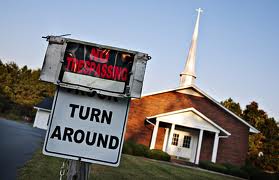
Rule #3: Members only! The building is not available for use by community groups.  These “outsiders” didn’t pay to build the building and they don’t respect God’s house. Besides, some of them will smoke on the parking lot. (By the way, a couple of well-placed “No Trespassing” signs will send the message to the neighbors).

Rule #4: No multi-use of rooms. Each ministry should have exclusive use of their room and keep the door locked. Be sure to include many signs warning people who are not in that group to “keep their hands off” of the materials and supplies in the respective rooms.

Rule #5: No change of decorations, furniture or room usage allowed! Never consider updating from pews to chairs, from the awesome “mural” in the baptistry to something more modern or creating fresh venues for worship or ministry. If the décor was good enough for grandma, it is good enough for us.

Of course, if you follow these rules, your building won’t be necessary. People won’t come to church. They will find a place that is inviting and will discover a faith family that cares more about them than they do bricks and mortar.

The bottom line is: Ministry is about people, not buildings! While we are not to needlessly abuse the facility, if it is not wearing out, we are not using it to its fullest potential.

What “rules” would you add?

Get Over Yourself and Ask for Help

images-118

I am being recalibrated. Until 6 months ago, I had enjoyed the kind of work and ministry that didn’t often require me to request the financial support of those around me. As a pastor of a local church for many years, we relied solely upon the generous donors in the church. They did this out of obedience to the Bible and commitment to the vision.

Now, as the leader of a ministry that requires the support of others in order to survive (a “mission state” for our denomination), I am compelled to ask outsiders for help. Interestingly, they are giving it. I am humbled and blessed to be a part of a faith family that believes in us and wants to invest in our future. I am learning how to ask for help.

This (the asking) does not come naturally for me. I still struggle to ask for money. But because I believe in what we are doing, I have to overcome that struggle.

There were 3 things I had to get over in order to be able to ask for a little help from my friends:

Pride: (arrogance, self-reliance). I simply had to come to terms with the fact that I needed help, that we could not do it alone. This is difficult for a leader to do. It is a humbling thing to ask for help.

Fear of being a pest: I do not like to be the one who makes others uncomfortable.  The thought that someone rolls their eyes when they see me on caller ID makes me cringe. I had to overcome that.

Disrespecting myself because we need help: We do not have less value because we are small in number.

It’s good for us to be in a spot where we need help.  This has been a healthy adjustment for me; a time of growth. I do pray and work toward the day when we will no longer need the financial assistance of our friends. I really want to be the one who provides the help to others, and we are trying to do that, even now. But thank God, we are getting by and even making progress as our friends are helping us.

Let me encourage you – ask for help when you need it.

God has no Grandchildren

fatherslove


I had the distinct privilege last week of meeting a pastor from Mongolia. This man is a pioneer Christian leader and is responsible for training young Christians who will shape the future identity of Christianity in their country. The Gospel is new in Mongolia. According to this pastor, as recently as 1998, there were only a handful of Christians in the entire country. Today, the are an estimated 400,000 Christians.

The Christian church is only one generation old in Mongolia.

The opportunities are significant because the people are hungry for God. Their hearts are pure. They have not been corrupted by familiarity.

I encouraged this pastor to fight hard to keep the people pure. We discussed the difficulties that will be faced by future generations. There is a tendency for people to drift from God. Each generation removed from an initial experience with God suffers lukewarmness. I talked to this new friend about the spiritual lethargy in America and how they can avoid this problem in Mongolia.

Every generation needs its own encounter with Christ. There is no such thing as hand-me-down faith. I explained to this humble pastor, the American phrase, “God has no grandchildren.” In other words, today’s generation must cultivate a personal relationship with God distinct from their parents’ relationships with God.

In America, we have a glut of the Gospel. Most everyone has seen and heard. Hearts are hardened.

We need a first generation experience with the Spirit of God.

Churches that Grow Spontaneously Shrink Spontaneously

spontaneous church growthIt’s a lot of fun when a church grows. Excitement builds, momentum is contagious, we’re on a roll. But if we are not careful, the roll can turn around and we fall faster than we climbed. That part is not fun – it is pure agony to the leaders who find themselves in a free-fall. Kind of like skydiving sans the parachute.

There are too many stories of churches that blew up with growth, then just blew up.
How do we prevent this shrinkage?
We need a God-given plan.

Some Spirit-filled leaders would argue that planning is the enemy of the Spirit. They would say that when God moves, there is no strategy involved, in fact, strategy puts God in a predictable little box. Here are my thoughts on that issue:

It’s not more spiritual to fly by the seat of your pants!

The Spirit of God seems impulsive but He is not. Nothing is done by Him that has not already been planned out and processed ahead of time. The problem is, He doesn’t always tell us ahead of time. So when He does something big we didn’t know about ahead of time, it feels spontaneous to us. But God is a strategic planner.  The genius of creation reveals God as a strategist. Soteriology (the study of salvation) proves it.

Acts 1:8 is church growth strategy. Look at the steps that Jesus lays out:
~Become powerful by being filled with the Spirit.
~Become witnesses.
~In Jerusalem.
~In Judea.
~In Samaria.
~To the ends of the earth.

Looks like at least a six steps in the strategy to win the world to Christ. Turns out, the Spirit is a planner. Who da thunk it?

If you want your church to grow, you’d better pray for a Spirit-inspired strategy. If you want to maintain that growth, keep moving forward and build momentum, you’d better work God’s plan.  Otherwise you may find yourself in a free-fall that will leave your stomach miles behind.

Collaborate or Die

creativity-collaboration-ideas


Collaborate: to work, one with another; cooperate. (dictionary.com)

1. God collaborates with leaders:

God has decided to reveal His plans to people. He usually selects a leader and fills his head with lots of ideas. But rarely do his plans involve only one person. God designed us to collaborate with others while we fulfill His plans.

About His plans, God says to us “Write down the revelation and make it plain on tablets so that a herald may run with it.” Habakkuk 2:2 (NIV)

We are supposed to communicate God’s plans with others. Then, other leaders can take up the vision and run with it (share it, help make it happen, pour it into the lives of followers).

2. Leaders collaborate with other leaders:

When Moses was about to burn out from doing all the work himself, his father-in-law Jethro gives some great advice:

Exodus 18:17, 21-24 “This is not good!” Moses’ father-in-law exclaimed. 18 “You’re going to wear yourself out—and the people, too. This job is too heavy a burden for you to handle all by yourself.

21 But select from all the people some capable, honest men who fear God and hate bribes. Appoint them as leaders over groups of one thousand, one hundred, fifty, and ten. 22 They should always be available to solve the people’s common disputes, but have them bring the major cases to you. Let the leaders decide the smaller matters themselves. They will help you carry the load, making the task easier for you. 23 If you follow this advice, and if God commands you to do so, then you will be able to endure the pressures, and all these people will go home in peace.”

24 Moses listened to his father-in-law’s advice and followed his suggestions.”

I would suggest that we share the workload with others who can lead.

3. Other leaders collaborate with followers:

My favorite Bible story about collaboration is found in Nehemiah. Nehemiah got the bright idea to rebuild the walls of Jerusalem. Apparently, collaboration was the way to go:

Nehemiah 2:18 “They replied at once, “Yes, let’s rebuild the wall!” So they began the good work.”

The insurmountable job was completed in 54 days!

4. Collaborative leadership results in a fulfilled vision!:

The only way you will accomplish all that God has put in your heart is to work in cooperation with other people. The vision you carry is too big and too important for you to try to do it alone. The only other option is failure, which means the death of your vision. Don’t let that happen – collaborate!

Pastor, There is a Target on your Chest!

13882422-young-businessman-showing-a-target-on-his-chest-under-his-shirt

Pastor, you are being targeted. It is no secret that if the enemy can take you out, many of your followers will also be taken out.

In Matthew 26:31 Jesus informed His disciples that they would scatter when He was attacked: “This very night you will all fall away on account of me, for it is written “‘I will strike the shepherd, and the sheep of the flock will be scattered.’ He was referencing the prophecy in Zechariah 13:8 which detailed His brutal death.  He was also telling them that none of them would be there for Him in His darkest hour.

If you are a spiritual leader, make no mistake; the devil is zeroed in on you. He has you in his crosshairs.

Should you be afraid? No, but you should take some precautions:

`Surround yourself with a prayer covering – both from yourself and from other people. This needs to be more than casual. Intentional and strategic prayer is needed.

`Don’t take unnecessary risks: don’t go where you don’t belong, stay away from the things that tempt you, avoid people that pull you the wrong direction.

`Maintain your spiritual disciplines. It is in prayer and meditation and fasting and the Word that you remain strong.

`Stay accountable. While solitude is important, too much time alone is unhealthy. Be close to your spouse, your family and your friends.

`Stay close to God – it is in Him that you are secure.

There is a target on your chest! Don’t underestimate your vulnerability and don’t undervalue God’s protection.

Poise

th-3It’s composure under pressure.
It’s remaining solid when the world around you is shaking.
It’s confidence, even in uncertainty.
It’s maturity when surrounded by emotionalism.
It’s security when being second-guessed.
It’s faith when what you see is troubling.
It’s vision in a dark room.
It’s control in chaos.
It’s the stuff leaders are made of.

If (When) You Fail, Don’t Lose Your Composure

images-111

I played high school basketball and was Captain my Senior Year. I also coached two years of high school basketball (going undefeated one season!). One learns a few things about the sport by spending that much time in smelly gyms. Here is a little insight: when a young player takes a shot and misses, there is an increased chance that within the next 5 seconds, he will commit a foul against the other team. Most inexperienced players who take a shot and miss it run straight to whoever gets the rebound and tries to steal the ball, only to be overaggressive and commit a foul. Why does this occur and more importantly, are there applications outside of sports?

I think it’s a matter of losing composure after failure. The kid is frustrated and wants to make up for the missed shot. He’s out to prove he’s a good ball player, so he overcompensates – and ends up fouling. I also think it is losing control of his emotions. The temper forces overreaction – and invariably the whistle blows.

It happens in life all the time. Somebody messes up, and as if things weren’t bad enough, they lose their composure. Bad becomes worse. Some basic coaching could help prevent these multilevel mistakes. I think the real culprit is a lack of maturity. A more seasoned player has learned that when he/she misses a shot, it’s best to go back and play controlled defense. A good coach will train players that it’s ok to miss shots but it’s not ok to make matters worse by fouling.

In life: Not if, but when you blow it – hold on to your composure. Don’t lose control of your emotions. Don’t overcompensate. Sometimes it’s best to fall back and play defense.

You’ll get another chance to take, and make, a shot.

Please Don’t Reject Hope

6294765917_27edd90858_zExodus chapter 6 in the Bible discusses God’s plan to liberate the Israelites from their slavery in Egypt. He laid out the specifics to Moses and Moses then delivered the plan to the people. Their response is depressing: “So Moses told the people of Israel what the Lord had said, but they refused to listen anymore. They had become too discouraged by the brutality of their slavery.” (Exodus 6:2) They rejected God’s plan. They had given up on the idea that they would ever be free.

What causes people to reject offers of help and hope? The Exodus passage explains that they refused to listen because they were “discouraged by the brutality of their slavery”. Their bondage had gotten the best of them. Their pain had caused them to give up. When people hurt badly enough, they can be tempted to reject hope. This is sad.

As if the pain isn’t bad enough…

God’s plan may now be derailed – if they refuse to believe and participate, things may not turn out the way God had planned. He wants them to participate in the escape process. If they don’t get involved and take action, their slavery will continue.

For sure, their misery would be compounded, without the hope of hope. The human spirit can endure amazing stress, if there is the promise of hope. Without hope, pain can destroy us.

No matter what you are going through today, please don’t reject hope. It may seem like there is no promise of things changing. But there is hope! If you reject hope, your chance of things changing reduces drastically. If you reject hope, your pain will intensify.

There is hope in Christ. Please don’t reject hope.

If you need someone to pray with you, feel free to contact me at rickwhitter@gmail.com or maybe I can help put you in contact with someone locally.

The Fight against Widow Burning

sati-mitul-vyasSati, an ancient Hindu custom practiced in parts of India until 1829, was the focus of William Carey, Christian missionary. In this practice, a recently widowed woman would immolate herself (burn herself alive) on her husband’s funeral pyre.  We are appalled at such a practice.

Carey, a preacher and social reformist battled the ancient custom, seeking respect and fair treatment of these marginalized women. They had no choice in the custom. It was Carey’s relentless 25 year war against Sati which finally led to the famous Edict in 1829 banning widow burning.

A few critics condemned Carey for entangling himself in cultural issues. He was denounced by some Christians for spending time doing anything other than preaching the Gospel. But Carey stood for justice and God’s Word in regard to the treatment of women. Thankfully, he had an impact.

There are issues in our American culture that, in my opinion, scream for our focus, as much as Sati did for Carey. There are societal matters that have become political – but at the root they are basic human justice issues. One such example is abortion.

While some believe that abortion is taboo for public discussion, I believe that a battle must ensue. In the spirit of William Carey, those who believe in justice for all people must begin to speak out and act out on behalf of these marginalized people. Too many babies have been killed and too many mothers have been destroyed. Taking the life of an innocent child may be acceptable in our society, but it is an atrocity that must be addressed – and stopped.

Hopefully, one day, people will hear of our custom of killing babies and be appalled. Hopefully, this atrocity will end.

The problem isn’t those who’ve never heard of Jesus. The problem is those who refuse to tell them.

An age-old theological conundrum is: What happens to the people that die who have never heard the Good News of Jesus?  Does God hold them responsible for something they have not heard? We know that those who reject Jesus will not spend eternity in heaven (Acts 4:12 “Salvation is found in no one else, for there is no other name under heaven given to men by which we must be saved.”). But will God send people to hell if they lived in a place where the Gospel has never been preached?

Without diving into a theological debate, we can rest in the fact that God is just and loving. He will do whatever is righteous and fair with these people.

Considering our cultural context, I think there is a more pertinent issue at hand:

The problem isn’t those who’ve never heard of Jesus. The problem is those who refuse to tell them.

I wonder what God will do with those of us who refuse to tell people about Jesus. What about those who are called to go to the parts of the world that have never been reached? What will God do with them (us)?

While we can’t say what God will do with those who have never heard, we should be concerned if He has asked us to tell them, and we refuse to do so.

cross retouched

Our Healing is Not Complete Until we Help Heal Another

images-98In my darkest hour, I received more help from a friend who had previously walked the same road that I was currently on. We were now fraternity brothers. And it somehow made me feel better to know that he got it.  He only said a few things, but they stuck – and made a difference. I have used the words he shared to help others.

If you’ve been through some stuff and made it, share it. The wisdom you gained by surviving can benefit the guy who is coming along behind you. It hurts to hurt alone. Reach out to someone who could use a pick-me-up and tell them how you got through it.

Not only will you help them, you will help you. Our healing is not complete until we help heal another.

If you got through it, you just gotta share it. Don’t hesitate to give what you know.

Jesus does that for us. He is close to you if you are hurting, He’s been there. He knows how you feel and can get you through.

God’s Will has Nothing to Do with My Feelings

personal-1

We sometimes mistakenly think that God exists for the purpose of making us happy. Be aware, however, our comfort is not God’s priority. While He is not into inflicting pain on His children, we cannot equate our good feelings with His plan.

I was challenged with this thought yesterday when we said goodbye to our 20 month-old granddaughter, as her parents were taking her back to the Guatemalan orphanage that they direct. It hurts to see her go. If I had the power to choose a different plan, I would. Yet we are absolutely convinced that they are within God’s will for them. His will for them results in a broken heart for me and my wife every time they get on that plane.

I can never make the mistake of thinking that because being away from my family hurts, God must be displeased. I think He is very happy, not with our pain, but with our obedience. He hurts when we hurt. He hurt when Jesus died on the cross, but He was pleased with His obedience.

Obviously, the presence of pain is not an indicator that we are within the will of God. We simply must not make ease of living or comfort in our emotions the litmus test for the fulfillment of God’s will for our lives.

If you are right smack dab in the middle of God’s plan for your life, and you are pain-free, congrats! For most of us, it costs a little more.

And shall I pray Thee change Thy will, my Father,
Until it be according unto mine?
But, no, Lord, no, that never shall be, rather
I pray Thee blend my human will with Thine.

I pray Thee hush the hurrying, eager longing,
I pray Thee soothe the pangs of keen desire—
See in my quiet places, wishes thronging—
Forbid them, Lord, purge, though it be with fire.

Amy Wilson-Carmichael

The New Year will be Just Like the Old Year, Unless…

iStock_000022082937Small-2013-Goals-830719_406x226-1

It’s not logical to repeat the same behaviors while expecting different results. For those of us who are motivated about a new beginning in 2013, I applaud you. However, be aware that if your work ethic, personal habits and spiritual focus are the same as they have been in 2012, 2013 will probably be a repeat.

Resolutions can be a great tool in assisting us in improving our life situation. We should use personal goals to motivate us toward behaviors that change our conditions. Most people require accountability both in the setting and keeping of goals. I highly recommend that you set goals and share those with someone you trust. Be realistic, make tough decisions about important issues and have a long-term perspective. Your chances of success will increase dramatically.

The truth is, if you can’t bring yourself to make any changes, get ready for more of the same. There really isn’t any reason to expect improvement. So, New Year, same old results, unless you change your approach!

There are some positive changes I plan to make for next year, so I fully believe that 2013 is going to be a great year – even better than 2012! Join me!

Christmas is Flesh and Blood

images-90We should know by now that the holiday is not about the presents we receive. It really is about people. There are people who actually have to buy their own presents because there is no one in their lives. They are missing the greatest joy.

My heart goes out to a friend who lost both her and sister and her mother this week. I lost my mother this year – Christmas will be a little different this year.  Then I think about the military personnel who are separated from loved ones this week. There are college students, widows, orphans, many people without people in their lives.  People who are incarcerated, even people who have to work through the holidays, will struggle to celebrate to the fullest extent. People make Christmas what I is.

Regardless of what marketers tell us, no amount of spending on presents will fulfill the purpose and meaning of Christmas. Christmas is about people: family, friends, and loved ones.

On the birth of Jesus, Athanasius of Alexandria wrote, “He became what we are that he might make us what he is.” Christmas is God coming in the flesh and shedding His blood – so that we might be saved.

It’s not lights, not trees, not Santa. Christmas is flesh and blood. Be sure to share the love with the people in your life.

Merry Christmas, everybody!