Shepherd or Hireling?

Church leaders are one or the other. The Scriptures are clear, the sheep belong to the Good Shepherd, Jesus. Those who serve churches are simply undershepherds. As such, we will give account to the Lord as to how we served His flock. 

So, what is a hireling? “A labourer employed on hire for a limited time. His wages were paid as soon as his work was over.” (Easton’s Bible Dictionary) 

“In the New Testament the word “hireling” (misthotos) occurs only in John 10:12, where his neglect of the sheep is contrasted unfavorably with the care and courage of the shepherd who owns the sheep, who leads them to pasture and lays down his life for their protection from danger and death.” (International Standard Bible Encyclopedia)

I have witnessed the behaviors and characteristics of both shepherds and hirelings, and have developed this simple summary: 

Pastors love the flock; hirelings love attention.

Pastors serve the flock; hirelings use the flock for their own selfish gain.

Pastors pray for the flock; hirelings prey upon the flock.

Pastors promote the flock; hirelings promote themselves. 

Pastors sacrifice for the flock; hirelings steal from the flock. 

Pastors build up the flock; hirelings build their brand. 

Pastors invest themselves into the flock; hirelings use the flock for the own benefit.

Pastors defend the flock; hirelings demand of the flock. 

Pastors are thankful for their flock; hirelings take advantage of the flock.

Pastors protect the flock; hirelings manipulate the flock. 

John 10:11-12 “I am the good shepherd. The good shepherd gives His life for the sheep. 12 But a hireling, he who is not the shepherd, one who does not own the sheep, sees the wolf coming and leaves the sheep and flees; and the wolf catches the sheep and scatters them.

When People Don’t Want Solutions

Have you ever been in a conversation with someone who had a problem, a worry or an offense? Of course you have. And have you offered potential solutions to that person, only to have them ignore or refuse to consider the proposed solution? Of course you have. And when that happens, you know you can’t help this person. In fact, you realize that this person is not interested in answers, they only want the problem. 

Several weeks ago, a leader-friend of mine shared how one of our colleagues had hurt him. I asked if he had addressed the problem with our colleague – he had not. And he expressed no interest in doing so. This conversation has been repeated many times with many associates. It is a common event.

In many cases, especially if we’re dealing with a supposed “mature” individual, these hurting people prefer to hold on to their hurt. They don’t want answers, they want an excuse to be offended or to worry. If they actually solved the problem, their ability to complain would be hindered. If they solved the problem, they would then be expected to produce results. As it stands, they have a “reason” to be stuck. Their hurt becomes their license to be bitter.

Try to help people, all the people you can. But when you come across a person who refuses to be helped, it may be best to move on to someone else until that individual really wants help. But when they’re ready, then be willing to jump back in to offer the help you have!

Lesson: Be teachable. Stay coachable. Be solutions oriented rather than problem oriented.   

Related post: Pastor, You Can’t Fix Everybody: https://rickwhitter.com/2016/05/13/pastor-you-cant-fix-everybody/

Leadership 101

Leaders must make the best decisions possible for the people and the organizations they serve. Sometimes, some people won’t like the decision, sometimes many people won’t like it, but leaders are tasked with assessing situations and making the calls that are necessary. This is not always easy. In fact, there are times that the last thing a leader wants to do is to make a tough decision in a contentious issue. But courageous leaders lead on, regardless.

Before reacting to a leader’s decision and before expressing disapproval, consider that the leader knows details that are not common knowledge, and an integrous leader cannot and will not share those details. Perhaps if we knew the details the leader knows, we would have a different opinion.

Remember, leaders will give an account to God for using discretion, discernment, and integrity regarding the organization and the people they are called to serve. And rest assured that in any respectable organization, the leader is also accountable to other leaders. Corrupt leaders will be judged, and honorable leaders will be rewarded – by the One who sees all and knows all.

So, pray for your leader.

Understand that they know details that you don’t.

Support your leader as much as you are able.

And know that, how you treat your leader is how you can expect to be treated by those you lead.

You Owe What You’ve Been Given

Most would agree, if we have any true success in ministry, it’s all the Lord’s, He receives the glory. But if He gives you success, does He expect more from you?

Yes, He does!

If the Lord helped you to build your church from 0 to 50 people, you have an obligation to teach others how to do so. If He enabled you to grow a church from 50 to 100, or 100-500, there are pastors just waiting for the information you possess. If God allowed you to be a successful evangelist, missionary, church planter or administrator, you owe it to the kingdom of God to teach others the ability that God has given you.

Some may say that they are too humble to tell others how they did it. They don’t want to be guilty of arrogance and hubris. It’s not arrogant to share the good news, it’s selfish to not share the good news.

Others may say they don’t know anyone who will listen to them. I say, find someone who is currently where you were before God allowed your progress – and offer to buy them coffee. Relationship will open the door for influence.

Still others are waiting for permission to share. They lack the pedigree or title or platform.

You don’t need permission to help others; your possession of knowledge requires you to help others!

This is the way God established it to work. He blesses us so we can bless others, He expects us to share. “When someone has been given much, much will be required in return; and when someone has been entrusted with much, even more will be required.” (Luke 12:48 NLT) We need those who have been blessed by God to show others how to be blessed.

This is Biblical church growth, this is Kingdom growth. Think about it.

What Motivates One to Lead?

The desire and ambition to be a leader is a very good thing. Leaders make good things happen for others. But the whybehind the desire to lead is crucial to understand.  If we have a leader who is motivated by the wrong thing, the Church is in for trouble. 

The need to be needed, the desire to be the focus of attention (selfishness), and wanting to be “in charge” will drive some folks into leadership, and will drive those around them to flee. Ulterior motives such as bringing down an enemy, making lots of money, manipulating others to serve and gaining notoriety are poison that will quickly kill an organization. 

On the other hand, sacrificing for the good of the movement, serving others, uniting and building up the Church, and moving the Church toward the Lord’s will are all pure and godly motives for leading.  

I Thessalonians 5:13 teaches us: “And we beseech you, brethren, that you come to know those who labor among you, and are over you in the Lord and admonish you.” “Know those” really means to acknowledge our leaders, but there is much to be said for knowing, understanding motives and discerning the intents and desires of an aspiring leader in the Church.

Let’s check our motives and remain pure in our desires. Let’s not be influenced or fooled by someone who is, with impure motives, chomping at the bit to take the reins. Let’s seek the Lord for discernment, let’s fast and pray for motives to be revealed, and let’s anticipate the Spirit’s direction in who will lead.     

The Coliseum of Social Media

But the lions are in the stands.

I’m afraid we’ve entered the age of a virtual coliseum where barbaric, human-spirit shredding is the preferred entertainment. The paragraph below provides a brief description of how depraved and cruel people were in Vespasian’s day. I believe they had nothing on our culture!  

“The Roman Colosseum Arena was a stage of combat for the gladiators and occasionally staged mock naval battles. Its 80,000 seat stadium inspired the gladiators, who were mostly slaves, criminals, or prisoners of war, to fight for their freedom. The horrors of the blood-thirsty crowd of thousands cheering on the gladiators’ fight for their lives leaves it to our imagination what entertainment meant to the ancient Romans.” (https://www.headout.com/blog/rome-colosseum-arena/)

One of the hottest tickets at the Roman coliseum was when Christians were mercilessly fed to hungry lions. They were savagely martyred as “fans” watched, ate their popcorn and jeered the bloody Christians.  

Today, bloodthirsty and merciless spectators are provided front row seats in the arena of social media to chant, humiliate, dehumanize and destroy those with whom they disagree. They have an opinion about everything. They pretend they can outperform everyone, regardless of their lack of actual usefulness. But they are so much more than spectators, they are virtual lions, digitally tearing people to shreds. 

This is how today’s coliseum differs from ancient Rome: the lions are not on the arena floor doing battle, the lions are spewing their hateful wickedness from the cheap seats. They are not engaged in the battle, they are too cowardly to risk their lives. So, they cruelly butcher those brave enough to actually fight. They sit on their mother’s couch, hiding behind their keyboard, and talk trash, fearless of repercussions.  

I personally know individuals who are in the very public arena, trying to perform their craft in a professional manner, who have drawn the ire of the crowds. These crowds won’t simply share their disdain for the lack of performance with family or friends, they take to the only place where they can say anything they want to say without consequence: social media. The cruelty is unimaginable in a civilized world. I personally believe we left that world behind a few years ago.  

If you are a productive member of society and become the target of these vulgar barbarians, take heart, you are not alone. Let’s not expect the lions to let up. They won’t have any mercy. They will take great delight in trying to destroy you. But they can’t make you quit unless you allow them.  

Stay in the fight, ignore the social media lions.

By the way, I am not currently a victim of these social media trolls, but I have dear friends and colleagues who are. To them I say, stay focused. Do your job. Let the lions roar. Perhaps they’ll soon become so intoxicated on flesh and blood that they pass out. 

History will prove that you were a warrior and they were nothing more than a roaring but cowardly lion. 

The Older I Get, the More Diligent I Must Become

As we do every year this time of year, Letha and I have been talking about next year: how to improve, how to be more effective, how to make sure we are maximizing our opportunities. While prayerfully pondering this, a thought came to me.

The older we get, the harder we have to work if we hope to to improve. When we were younger, maturing and growth allowed us the presumption that we would improve with age, and most of the time we did. Simply living and learning about life allowed us to progress in our effectiveness. But now, improvement comes with a greater cost. Now that I am a more seasoned leader, I can’t just pass time and get better at things, I actually have to be intentional in my growth. What a revelation!

Allow me to explain. I have less energy now than I did when I was forty. So if I want to stay in good shape physically, I have to discipline myself to get off the couch and move (which I do!). Like many my age, my natural tendency may be to go with what is comfortable and familiar. But my comfort zones destroy my productivity! Now that I’m older, I enjoy my old friends. But as important as my old friends are, I need to stretch and grow in relationships, networks and connectivity. I can’t just recline in the “Lazy Boy” of life and expect to advance; I’ve got to be purposeful, intentional and action-oriented.

So if 2022 is going to be a better year than 2021, I have to work harder and think harder and behave harder than I have this year. Slothfulness and resting on my laurels (*info for this reference below) will defeat me. As a leader, the older I get, the more diligent I must become.

I want to improve until the day that I die. I want to be a better Christian, husband, father, Pop (grandfather), friend and leader. That won’t happen organically; I must work to improve.

So look out New Year, I’m coming for ya! I’m excited about 2022!

*https://www.phrases.org.uk/meanings/rest-on-his-laurels.html

Beware of Leaders Who…

The world is desperate for competent leaders. Sometimes we are shocked at how few quality people are willing to lead. In our desperation, it’s important that we not follow those who are unscrupulous, who have ulterior motives, who will lead us astray. 

My advice is, keep you guard up and beware of leaders who…  

Know all the answers.

Are quick to correct others.

Like to point out flaws.

Think they are the guardian of all truth.

Disrespect or dishonor others.

Are condescending to others.

Like to be in the spotlight.

Talk more than they listen.

Are cynical, sarcastic or cruel.

Are above correction, suggestions, input and collaboration.

Are politically motivated.

Are hot tempered, out of control emotionally.

Use people to get what they want.

Need to be in control.

Take the credit when things go well and blame others when things go poorly.

Treat “important” people better than the “unimportant” ones. 

Never say, “I was wrong”, “I’m sorry, and “thank you.”  

Matthew 20:26-28 “Not so with you. Instead, whoever wants to become great among you must be your servant, and whoever wants to be first must be your slave—just as the Son of Man did not come to be served, but to serve, and to give his life as a ransom for many.”

When Leaders Flail

design-65.pngThat’s not a typo.

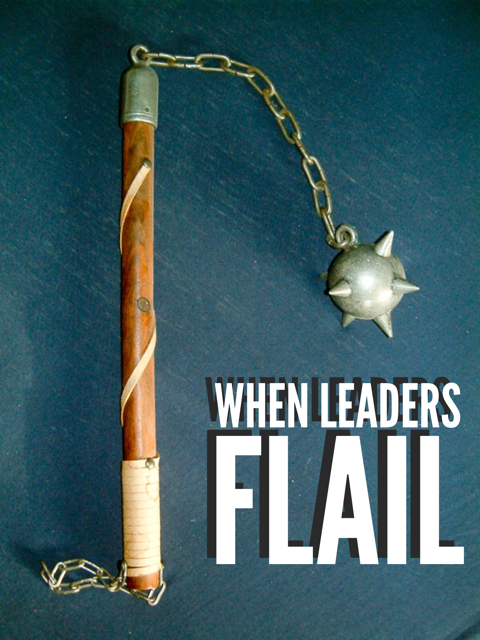
Although I am addressing how some leaders respond in times of failure, flailing is my focus. The word flail can be a noun or a verb. As a noun, it describes a primitive weapon, composed of a strong stick or pole, some type of rope or chain and a metal spiked ball at the end of the chain (picture courtesy of Google Images).  It was used in medieval times as a close-combat weapon. You can imagine the devastation it would cause an enemy. The verb form deals with a person who swings wildly, usually in a desperate attempt to overcome a dangerous situation. We see this kind of fighting in undisciplined street fights. Opponents don’t use fighting skills as much as they use brute strength, panic and a little bit of luck.

Let’s talk about flailing leaders. This type of flailing may not involve throwing punches, but it does involve wild responses. It happens when…

Under attack from an enemy.

In danger of being hurt.

Panic from failure sets in.

One doesn’t know what else to do.

Granted, it doesn’t happen in every one of these situations, but we’ve all seen it. A leader loses control of their assignment or themselves. They feel backed into a corner. They perceive a threat. So many of us come out swinging. They may yell, threaten others, try desperately to defend themselves or try to hurt others. We’re not sure who we are going to “hit” but someone will certainly get hurt.

I’m trying unsuccessfully to recall when a flailing leader came out looking good. I can name dozens of cases where a leader looked foolish while flailing.

Here are some things to remember the next time you are cornered, threatened, unsure, intimidated or in danger.

Once a leader loses their composure, things head downhill rapidly. People observe our reactions and responses. They watch closely what we do and say. They judge us as a leader based on our behavior. And many of them never forget what they observed. Years of trust building can be destroyed in a moment of flailing. Self-control is a vitally necessary characteristic for today’s leaders. If you lack control or are undisciplined, you will pay a big price. Poise is the ability to remain in control of one’s responses even when the situation is out of control. Poise under pressure is one of the most desirable traits for current leaders. People will trust and follow a leader that doesn’t panic. Maintaining equilibrium when things are falling apart allows a leader to help and serve others who desperately need them. Don’t get knocked off balance!

A flail (noun) is hard to control. Sometimes, people are hit unintentionally. Innocent bystanders can and will be damaged. And sometimes the person wielding the flail hits themselves. Sometimes, the blow is fatal.

Here’s the point: when leaders flail, people get hurt. Rather than helping people, we do damage.

The lesson is – prepare yourself ahead of time to respond to bad situations. Arm yourself with self-control, steady thinking, and the ability to remain calm. The next time someone or something threatens you, don’t fail by flailing! Your poise under pressure will serve you well and it will serve well those you are serving.

Leader: Who/What Validates You?

design-56To validate means to “recognize or affirm the validity or worth of a person.” (Dictionary.com). Before we get spiritual and argue that God is the only one who validates us, let’s be real.

Leaders are human and humans have weaknesses. Many of us struggle from low self esteem issues. We are insecure. Many leaders battle feelings of insufficiency and lack of qualifications. Being validated as a leader is not only helpful, it is necessary if we hope to survive the challenges that leaders regularly face.

Receiving recognition from those you lead is nice. Being honored on a special day or with a gift is affirming. When our leaders notice and comment on our work, it can be very motivating. Any time anyone says, “thank you”, we may feel validated.

But I believe we must be careful about who or what makes us feel good about ourselves as leaders.

Increasing productivity can validate us. Being named to a position of leadership, getting invited to speak at a special gathering or receiving an award can build our self esteem. But there is inherent danger herein.

Needing the public recognition or verbal affirmations of others in order to feel like a leader is dangerous. Those who must have a pat on the back may become vulnerable to people pleasing. Additionally, if we can be inflated by praise, we will become deflated by criticism.

I suggest our validity come from deep within ourselves. Leaders must know who they are in Christ. This does not mean that we don’t need the support and encouragement of others, on the contrary. But we can’t place our self concept in the hands of other people.

God called you as a leader, you responded. That response will include days when no one sees or talks about what a great leader you are. We’ve got to be ok with that.

Don’t feel less significant because your numbers are down. Don’t live or die based upon the opinions of others. Don’t count on the affirmations of others in order for you to understand your value.

You have family and close friends. Go ahead and allow them close into your heart and head. But even they shouldn’t be your sole source of validation.

You are valuable, you are needed, you are loved. That’s not validation coming from me, that’s validation coming from God.

Why I’m Thankful

design-54My wife will tell you, very often, as we are traveling about, I openly express my sincere thanks to God for His goodness to me. It is one of the most humbling thoughts to realize that God freely provides His gracious love to us. When I am in a healthy spiritual place, gratitude is one of my most common emotions. There are a few reasons for this.

I know what should have been. Only the Lord and I know what I was, and at times, still am. It is perfectly logical to think that I should have been destroyed. If I had reaped what I had sown, I would not be here. This is in no way a glorification of a dramatically bad boy life; far from it. I simply was a rotten person, and should God have chosen to give me my dues, I would have been done long ago. I am thankful that I am not yet done.

I know what could have been. Because of my early foundation, it is not beyond comprehension that I could have been destroyed. I could have gotten trapped in a miserable, desolate life. I could have spent my days in frustration and failure. I could have easily lived out my life in uselessness. I could have been consumed with pain, grief, addiction, despair and destruction. I am thankful that what could have been did not become reality.

 I know what wasn’t. My wife and I know the pain of losing a child. For the last many years, we have been impacted by our loss. Every holiday, every day we feel the pain.  This influences us at Thanksgiving because we are grateful for what we had, and then lost. It makes us treasure what we have. I am thankful for what we have, and for what we have lost.

I know what won’t be. I’m not getting any younger. My current situation is fleeting. My family is growing, the babies are getting big. My experience is fast, time is passing quickly. What I see now won’t last much longer. I am thankful that I have what I have now, and I plan to enjoy it to the fullest. I am grateful that, although passing quickly, life is very good for me.

So, I’m thankful. So very, very thankful for all that God has done and is doing for me.

I never want to lose that. Thank you, God.

Shepherds: the Sheep are Watching

design-26While it should be intuitive, I think it needs to be said: people follow their leaders. Leaders influence and impact. Those who lead others must understand their responsibility. Those we lead watch our behaviors. They listen to us talk. Whether intentional or not, followers pick up traits and characteristics from their leaders.

But some of the influence wielded by leaders morphs into, perhaps, unanticipated results. It may be assumed that a happy leader produces happy followers, but it’s not that simple.

At the risk of over simplification and generalizations, I think…

Angry shepherds lead wounded sheep.
Critical shepherds lead insecure sheep.
Disconnected shepherds lead wandering sheep.
Shallow shepherds lead vulnerable sheep.
Arrogant shepherds lead cynical sheep.
Manipulating shepherds lead confused sheep.
Selfish shepherds lead hungry sheep.
Doting shepherds lead entitled sheep.
Cowardly shepherds lead endangered sheep.                                                                                                                                            Rebel leaders lead rebellious sheep.

And

Compassionate shepherds lead recovering sheep.
Gracious shepherds lead transparent sheep.
Patient shepherds lead confident sheep.
Courageous shepherds lead secure sheep.
Consistent shepherds lead stable sheep.
Kind shepherds lead trusting sheep.
Nurturing shepherds lead healthy sheep.
Engaging shepherds lead connected sheep.
Serving shepherds lead committed sheep.                                                                                                                   Empowering shepherds lead growing sheep.

Of course, these are not written in stone, but you get the concept.

Leaders carry the heavy load of being influencers. If you are a leader, lead well. The wellbeing of the people you lead is dependent upon you.

Shepherds: the Sheep are Watching.

The Sword

There is a beautiful and powerful scripture verse in I Samuel 21:9. At a point of desperation, David is in need of a sword. The only one available is the sword that he took from Goliath when he had killed the giant some time earlier (see I Samuel 17). When offered the valuable and rare sword, David said, “There is none like it; give it to me.”

This verse is powerful for us because it indicates the value of victories won. When God brings us through a potentially destructive time and we overcome, something significant happens within us. We have seen God do the impossible. A standard for impossible victories is established. From this time forward, we have no need to fear battles. We are able to return again and again to the time of miraculous deliverance, and we trust God, regardless of the challenges at hand.

From time to time, I need to go back and recall the specifics of when God came through on my behalf. There are some swords that are very valuable to me; the swords that decapitated some of the giants I was facing. These swords are proven, trusted. And they provide the confidence I need to slay another giant.

While every battle requires its own strategy, there is nothing like the proven, trusted and effective Sword of the Spirit, the Word of God.

When in peril, my response will be: “There is none like it; give it to me!”

Let’s Own the Problem

design-1We frequently complain about the condition of the world. I often hear pastors and leaders grumble about the condition of the church they serve. Family members freely voice their disappointments with their family. Employees criticize their supervisors. It seems to be the way of the world.

But here is a thought: Let’s own the problem.

By “owning”, I am referring to the opportunity we have to accept responsibility, perhaps not for creating the problem (although at times we are guilty), but rather, for discovering the solution to the problem.

Sometimes, we like to remove ourselves from the work. We observe a big dilemma and the only answer is a lot of hard work – so we stand on the sidelines and shrug our shoulders. Or, we inherit a bad situation and it’s frustrating to see what a mess someone else has made. In these cases, it is easy to exonerate ourselves from responsibility.

I want to make 2 points very clear here:

  1. Leaders must be willing to clean up messes they did not make

and

  1. If you refuse to be the solution to problem, you are part of the problem.

Pastor, if you’ve been at your current church for more than 3 years, you own the problems, whether or not you created them. No more blaming your predecessor or the church members. If the church has a bad reputation in the community, repair it. If the leaders have no vision, train them. Politicians cannot continue to point fingers at the other party. We didn’t elect you to blame; we elected you to lead. If your neighborhood park is rundown, you can fuss about it on Facebook, or you can organize the community, raise some money, and go to work. Own the problem!

Keep in mind that God has a strategic plan for your life and if you are living in obedience to Him, He has you right where He wants you. Did He place you where you are only to be an observer? In His infinite wisdom, did He create you to be a complaining bystander? No, He put you in your current role so you can bring solutions to problems around you. You can no longer afford to be one who only points out problems – you must now be a solutions-oriented leader!

Moses didn’t enslave the people but God asked him to lead them out of slavery.

Joseph didn’t create the famine but God sent him ahead so he could rescue the entire nation.

Paul didn’t create the storm in Malta but God used him to save all 276 on board the boat.

Please notice that, in the cases above, owning the problem was painful. It cost the problem solvers a great deal. They suffered. But each of them accepted their role. And countless people were eternally indebted to them.

Let’s not minimize the cost of owning today’s problems. Let’s also not mistake this concept for becoming a “fixer.” You are not the Messiah; it is easy to get out of balance in your quest to bring answers. But within the proper parameters, one person can have an incredible positive impact on the dilemmas of this world.

One of the biggest responses we will hear from this proposition is: “the problem is too big for me. I don’t know what to do. It’s out of my scope of capabilities…” Keep this in mind: God can do anything. If you are on His side, if you are working on His team, He can bring the solution. But many times, YOU ARE THE SOLUTION! By this statement, I mean that God has placed the person with the perfect gift mix in the critical place to have the greatest impact in the process of removing of the obstacles that hold people back. You are that person. Let’s accept our role as problem solvers.

Problem solving is an art form. It requires great faith, vision and people skills. Not everyone possesses these gifts, so those that do must exploit them. Until we engage, develop and deploy these problem-solving skills, the problems will persist, and increase.

Keep this in mind: if you can’t or won’t engage the trouble, if you refuse to take ownership, perhaps God will appoint someone else who will.

Until we see ourselves as “owning” the issue, unless we take the reins to lead our way out of a problem, we will continue to make excuses – and the problems will plague us as well as the people we love. It doesn’t have to be that way.

Let’s own it.

Can you Play the Theme Song from Charlie Brown?

Several years ago, I knew a guy who could play the song on the piano, and he could play it very well. At many church social events, he would find his way to a nearby piano and begin to play the song. People would stop and listen and laugh along and talk about how awesome he was. He kept doing this for a while, until people got used to it.

This happy little song brings about warm feelings for many. They think of holidays as a kid. The title of the song is “Linus and Lucy” and it was released in 1964 by jazz pianist, Vince Guaraldi. I’m guessing the song will stay in your head the rest of the day.

At one event, I talked to the guy at our church about his remarkable talent to play the piano. And he told me something unusual. This was the only song he knew how to play. He never took lessons, he didn’t study music. He explained that, as a kid, he spent a lot of time alone. His parents had a piano, so he taught himself how to play that song – only that song. So, apart from the occasional show off session at church social functions, his talent was useless. It served no productive purpose. In addition to being really unusual, it always seemed like such a waste to me. Obviously he had some natural ability. If he had honed those skills and invested his time and energy in something in addition to that one song, who knows what he could’ve done?

Many leaders are “one song leaders.” They have one skill; one talent. Maybe they can sing well or preach powerfully or perhaps they are a good-looking person with a magnetic personality. They ride this talent as often and as far as they can. But much like the guy who could play only one song, they are limited in their effectiveness because they never develop anything more than their “go to” skill. They are able to put on a show, and initially attract a crowd, but eventually people get used to the same old offering and begin to ignore him or her.

Here is the sad part. That guy kept playing that song although people were no longer impressed. This was the only way he knew to get attention, and it no longer worked. I wonder how many of us are still doing the same thing that used to work – but it no longer works? Listen, sometimes, what was effective 10 years ago may no longer be effective today. That is why good leaders grow. They develop new abilities. They are smart enough to recognize when the same old song isn’t cutting it anymore.

Leaders, this is no time for pride or stubbornness. If what you are doing is not working, you need to adjust. If you find fewer people willing to follow, learn a new song. Even better, learn how to “play the piano”, not just one song.

Who Should Be A Pastor? (10 things a pastor must be able to do)

There are a few jokes about the perfect pastor that continue to make the rounds:

35 years old with 30 years experience.

Doesn’t dress too flashy or too trashy.

Has a lovely but modest wife, and 1.5 well-behaved children.

Can preach, teach, sing, play, administrate, cut grass, clean toilets, visit all the sick and elderly, attend all the church kids school plays and ball games and find time to pray for 3 hours every day.

These are jokes.

But it’s not funny when we see a person trying to serve as a pastor when they lack some basic necessary gifts and abilities.

From my 30 plus years in ministry, I have a few (10 for now) indispensable skills a successful pastor must possess. Please, let’s take some for granted. In other words, don’t scold me for omitting praying or whatever. These things are obvious. The points I want to cover may not be as obvious.

1. Must be able to personally lead someone to Christ. It is shocking to learn that some pastors have never led anyone to salvation outside of a church service. If the pastor doesn’t, the people won’t.

2. Must be able and willing, even eager, to work hard. Sometimes the work is manual, sometimes it is intellectual, but it is always strenuous. In my opinion, pastors cannot work less than 50 hours per week on average if they hope to build a growing, effective church. While we must prioritize our family and health, excessive television, golf, napping or any other “recreation” is a sign of slothfulness. Please don’t be guilty of adding to the “lazy preacher” perception. Of course the above numbers are considering full time pastors.

3. Must be humble. Arrogance, pride and an inflated ego by a pastor will destroy a ministry quickly. Get over yourself.

4. Must be a learner. Whether the education is formal or informal, there is no space for intellectual anemia. You never know it all so learn until you die. You speak on behalf of God; know what you’re talking about.

5. Must not be a racist. Now, this should be a given, but it is not. Pastors cannot discriminate against people of other races or nationalities. Mistreating anyone is not allowable. If you cannot love all people equally, and minister to anyone, you disqualify yourself from effective ministry, and perhaps Christianity altogether.

6. Must be compassionate. Some score higher on the mercy scale than others, but a hard-hearted pastor is an oxymoron. Shepherds must care.

7. Must value other generations. If you can only lead people who are close to your age, you have a very limited harvest field. If multigenerational ministry doesn’t come naturally to you, work on it. The long term effectiveness of your ministry is at stake.

8. Must not fall in love with methods, style or genres. If you simply must preach a certain way, or if you only allow a certain type of worship music, or if you insist that church ministry be conducted in your preferred method, perhaps there is an ownership problem. The ministry does not belong to you; the ministry belongs to the Lord. God never changes. But times change, people change, and what’s effective in ministry changes.

9. Must be accountable to and for others; must be responsible to and for others. Independent pastors (those who answer to no one) are operating outside of biblical guidelines. Followers should not follow this type of a leader.

10. Must be able to increase the impact of the church they serve. If a pastor cannot lead the church to grow, the church will die. A pastor that leads a church to die isn’t a good pastor.

Well, there is the list of 10. Of course, there are tons more, perhaps they will come in the future. In the meantime, pastor on!

5 Quick (and Easy) Things You Can Do to Improve Your Leadership Skills

design1. Strategic Reading. No one who leads has a lot of extra time to read everything. And so much of what is available is redundant or shallow. Find your theme, do your research and read. Read less but read deep. Don’t try to retain everything or read too much, but read, and do so strategically.

2. Network with Similar Souls. You need to know you’re not alone. Isolation is dangerous. You need to be encouraged and you need to encourage another leader. Find a friend with whom you can commiserate. Make one another better.

3. Network with Someone who is Different. Don’t sleep with the enemy but find someone who opposes you, stands for the “other side” of things. Don’t argue; dialogue. Don’t seek to change them, seek to gain info, understand more deeply, and learn.

4. Commit to Grow (until you die). When you stop improving, you start failing. Keep learning new things; stay challenged. This requires humility and passion.

5. Serve someone. Don’t look for someone who can pay you back. Don’t serve to be seen. Find someone who doesn’t deserve it. Serve them. Keep quiet about it. Service is the core of leadership.

Ok, I misled you. I said in the title that these things are quick and easy. They are neither. In actuality, these things are hard, sometimes very hard. However, the more you practice them, the quicker and easier they will become. And the impact they will have on your leadership skills makes them well worth the effort. Put them into practice, you and those you lead will be glad you did.

Encouragement for the Dis-Couraged Leader

designI purposefully hyphenated the word discouraged.
The prefix “dis” is defined this way: “a Latin prefix meaning “apart,” “asunder,” “away,” “utterly,” or having a privative, negative, or reversing force.” (dictionary.com)

So, a person who is discouraged is the opposite of courageous. Perhaps not cowardly, but certainly far from brave.

Unfortunately, this describes many leaders I know. Confidence eludes them. Optimism is a million miles away. Is this because they are poor leaders? I don’t think so. I think the source of discouragement is much deeper than a performance consideration. But rather than dig into the cause of discouragement for leaders, I want to spend a moment exploring reasons to be encouraged.

Think about this:

You see only with your eyes. The true measure of your work is probably unseen physically but it is revealed spiritually. In other words, you don’t know the good you are accomplishing. Don’t get too down over a lack of measurable progress. I think you are having a greater impact that you realize.

You are not called to be successful in the eyes of the world; you are called to be faithful to your God. Our culture measures success by the amount of money and fame we possess. Like the weather, these things can change in a moment. God defines success by faithfulness. You’ll never be a celebrity, but you will be rewarded for obeying the Lord – whether or not you are famous.

You are not alone. Leading is the loneliest job in the world and sometimes the solitude can result in discouragement. Jesus has promised to be with you to the very end. And you have colleagues who care about you. Maybe they are too busy to let you know, but you are important to them. And by the way, don’t be too busy to check in on your leader-friends.

Your discouragement can actually become a tool to help others. Most of the people you lead are currently dealing with a similar issue. They are looking for a way through the puzzle. Who better to lead them than one who has recently escaped from the maze of discouragement? If you stay stuck in the trap of being downcast, they will stay stuck with you. Lead yourself and others out of the cloud of discouragement.

Your hard work and dedication will eventually pay off. One of the sources of discouragement is fatigue. We simply get tired of pushing the rock up the hill with no end in sight. Anybody can be happy when everything is going well. But true leaders have to forge ahead against the wind and in the face of lots of opposition. This can wear you down. But please be aware that the investments you are making now will have big results. It is a spiritual law that cannot be broken – you reap what you sow. If you will be faithful, even in the little things, God will multiply it.

One day, when the journey is finished, I believe that you will receive the ultimate affirmation. The Scriptures tell us that, if we remain faithful, we will stand before the Lord and will hear His words: “Well done good and faithful servant. You have been faithful in the small things, I will make you ruler over many things. Enter in to the joy of the Lord!” How awesome is that? While you may not see the finish line, it’s close. Don’t give up!

Rather than offer a lot of spiritual-sounding clichés, here is something practical: It’s the leaders in the world who make things happen. It’s not easy (it if was, everyone would do it!). If you are compelled to be a leader, you must lead. The only other option is quitting and then you become part of the problem rather than part of the solution. Steel yourself; prepare your heart. Strengthen your backbone. Develop greater courage. And if you need help with this, reach out to another leader. They get what you’re going through.

Finally, glean from the truth of this passage: “Why am I discouraged? Why is my heart so sad? I will put my hope in God! I will praise him again–my Savior and my God!” (Psalms 43:5)

Dis-Couraged Leader, encourage yourself! Lead on!

Can Kickers, or the Hezekiah Syndrome: Selling out Future Generations

27459680_10156150146009214_7268989353369031812_nIt’s commonly referred to as “kicking the can down the road.” This is when a leader refuses to deal with an issue that will have negative ramifications – later. The idea is, as long as I am gone when everything hits the fan, I’m good with that.

One of the most notorious cases of “can kicking” happened a few thousand years ago. The Bible tells the story of King Hezekiah who foolishly showed off all of the national treasures to visitors from a distant land. Isaiah (who was a prophet) addressed the trouble that would come as a result of Hezekiah’s mistake:

Then Isaiah spoke to Hezekiah, “Listen to what God has to say about this: The day is coming when everything you own and everything your ancestors have passed down to you, right down to the last cup and saucer, will be cleaned out of here—plundered and packed off to Babylon. God’s word! Worse yet, your sons, the progeny of sons you’ve begotten, will end up as eunuchs in the palace of the king of Babylon.”19 Hezekiah said to Isaiah, “If God says it, it must be good.” But he was thinking to himself, “It won’t happen during my lifetime—I’ll enjoy peace and security as long as I live.” (II Kings 20:16-19 MSG)

This is a little shocking. How, in good conscience can a king show such disregard for his family and descendants?

Take another look: Hezekiah said to Isaiah, “If God says it, it must be good.” But he was thinking to himself, “It won’t happen during my lifetime—I’ll enjoy peace and security as long as I live.” In other words, I really don’t care about what happens to people in the future – I’m OK.

Prototypical “kicking the can down the road!”

In a nutshell, here is the root of the Hezekiah syndrome:

Selfishness: when leaders care more about their wellbeing than that of those they lead, the phenomenon occurs.

Shortsightedness: when leaders can’t anticipate the long-term results of their decisions, those in the future may suffer.

When leaders don’t care about those who will come behind them, careless and even cruel decisions can be made.

When leaders are too weak to make decisions that are good for their progeny, the Hezekiah syndrome will reveal itself.

And this last “root” is worth focusing upon.

It is possible that leaders in 2018 may make decisions (or refuse to make decisions) that will hurt their children, grandchildren and many generations to come. If I am hurting the future by ignoring an issue today, shame on me.

If you are a leader and you observe a problem that may hurt others down the road, and if you have the capacity to address that problem, it would be a dereliction of duty to let it go. True, the results may not come about on your watch but it is immoral to be able to prevent future pain and not do so.

Leaders, our children need us to be strong. Our grandkids are counting on us having a backbone. If we see a problem that is fixable, fix it!

Now, apply the principles of the Hezekiah syndrome to your family, your business, your church, your community, your country… Your descendants will thank you!

The Pain of Weak Leadership

designWe have studied the leadership principles that state, “the leader sets the pace of the team.” Another way of saying this is, the quality of the team is determined by the person who in charge. While there are a few exceptions to this rule, I believe the principle is true.

I firmly believe that the pain of our current culture is an indication of weak leadership. While no elected official has the power to stop a mass murderer or to prevent natural disasters, leaders have the responsibility to affect positive influence to the point that the culture shifts in a positive direction. The current trend of our culture indicates, in my opinion, weak leadership.

The world is screaming for stronger leaders, integrous leaders, leaders with character. And more leaders!

What happens if we don’t respond?

Proverbs 29:2 “When the godly are in authority, the people rejoice. But when the wicked are in power, they groan.” NLT

This is a season of groaning. Our flags remain at half-mast much of the time. Rather than moving the people toward God, many leaders divide the people, bicker over political ideologies and posture themselves in an effort to look good. When things go wrong, people need someone to follow. Huston Smith said, “The most powerful moral influence is example.” People are desperate for someone to lead them out of this state of horror. Godly example is what we need. Where are the leaders that God has called?

We can’t blame the current leaders – they have simply stepped up to lead when other more qualified people have refused to do so. (See Judges 9:8-15) If we must blame someone, perhaps we should blame the strong people who are called to lead but refuse to do so.

And leaders – when we complain about our families, communities churches, or country – we must realize that we are incriminating ourselves. If the organization that I lead fails, I must assume the responsibility to fix it.

I’m calling out my friends. If God has compelled you to lead – please do so at the highest level possible. You’re not the leader of the free world but you lead your family. You can’t impact global change but you can lead your church to renewal. You can’t solve the world’s pain but you can lead yourself in being a stronger and better person. This is not a time for leaders to take a back seat. We can’t retreat. We can’t burn out and leave the task to others. The world can’t take much more of this.

“Someone must do something!” That someone is you.