cutting the grass and other leadership exercises

While some may disagree, I consider myself a relatively bright person. This afternoon, I had reason to second-guess my presupposition.

I haven’t cut grass in eight years. Until recently, we lived in a development that took care of outside maintenance – nice, but expensive.  With our recent move, I picked up the responsibility of mowing the lawn again.

Today was my first time with the new lawn and with the mower that was left behind for my use.  I added some gas, looked over the machine and cranked her up. Understand, our lawn is very hilly. It was hot, the grass was a little wet, and I was working pretty hard, especially on the uphill parts. About ¾ of the way finished, I happen to notice a level on the mower I hadn’t yet seen.  I pulled it and the mower started pulling itself! Awesome! But I felt kind of stupid. My last mower was self-propelled, but I made the assumption that this one was not, WITHOUT TAKING TIME TO LOOK.

Stop laughing.

Leadership lesson: before jumping into a project – take time to examine all of the details available:

What do you have to work with?

Is there a strategy or plan or method that will bring more success?

Is there an easier or smarter way to do this job?

What about efficiency…will you be getting the most out of your efforts?

Taking time to fully understand the details of what you are doing, what will be required and the best way to get the job down will make your responsibility and your life a lot more enjoyable. And you will be way more productive!

Once I kicked in the self-propelled feature on the mower, the job was a breeze. But the first hour and a half were not fun. I want to have fun working and leading.

Next week, I will cut the lawn in half the time with half the effort. Now if I could only find that self-propelled feature on some of the people I get to work with! (Just kidding!)

the value of catching up

We drove about 550 miles yesterday. I spent a good portion of that time talking on the phone with friends, some current and some old. All of the friends I spoke with are colleagues in ministry. They live in different states, and serve in different capacities, but our lives are intersected – we are friends. The conversations were interesting: Some friends were encouraging me. Some were looking for a little advice. Some were hurting and needing a lift. Some just wanted to shoot the breeze. But these conversations were all valuable and necessary. I loved making good use of otherwise useless time. It was productive, both relationally and spiritually.

Here’s the thing: I seldom take time to just call friends to see how they are doing.  By this I mean that people who are not necessarily under my sphere of responsibility sometimes get left out of my life – but this is unintentional. I’m not much of a phone guy and therefore I neglect people whom I shouldn’t. I get busy. As a result, I sometimes miss out on the lives of my friends. I am not available to encourage them or be encouraged by them. My experience yesterday was a reminder of how important catching up really is.

I hope to be more intentional with my friends in the future. While my friends may not be looking for a call from me or even be needing me to call them on a certain day, still, we need to talk. That’s what friends are for.

Be intentional in catching up with friends. Call someone. It’ll do you and them some good.

I love change (and that can get me into trouble)

I’ve always been the restless kind. I have spent a significant portion of my life with the strange feeling that the action must be happening somewhere other than where I was at the time – that I was somehow missing something. I tend to lose interest in routine, predictability isn’t attractive to me. And ruts are despicable!

All of this can create real problems, especially for someone who desires to be an authentic and credible leader. If I followed my desire for frequent change, I would never put down roots. Thankfully, God has helped me to harness my emotions and I have served long-term throughout my ministry career.

I had to wrestle with my restlessness during my recent decision to accept a new ministry post – I had to be sure that my wanderlust wasn’t driving my transition.

When considering a transition, here are some key questions to ask yourself:

Am I just bored with the routine of my current job?

Is the grass really greener over there? (you know the old joke that the grass is greener over the septic tank?)

Has something happened that may have caused me to become discouraged and consider quitting?

And the bottom line question: Is God driving my desire for a change or is it only human emotion?

My advice? If you are young and unencumbered, hit the road, see the sights, it’s OK to be a bit irresponsible. But if you are responsible for others, settle down and only move IF God is saying to move. If God is telling you to move, you really need to do it – regardless.

Embrace whatever God embraces – changing or remaining.

should I leave my net?

Today I am thinking that it is more difficult to follow Christ than it was back in the days when He walked the earth.

I read how, when Jesus called His disciples to follow Him, they dropped everything, “they left their fishing nets” and followed Him (Matthew 4, Mark 1) . This means they quit their jobs, without 2 weeks notice, and went after Him.

Letha and I are in the process of moving, we believe at the direction of the Lord. It is a PROCESS. Did the disciples have to contract a moving company, sell their homes, collect and pack about 100 boxes of stuff, close bank accounts?… You get the idea. I would be considered irresponsible if I dropped everything and moved to Minnesota. In fact, I would get into legal trouble if I left some of this stuff undone. But I believe that this topic may be more a matter of the heart than a matter of U-Haul.

Here are some important points about following Jesus:

-We must be ready to change direction, without a moment’s notice.

-Anything that we possess that would keep us from being obedient to Christ has become a false god to us.

-Our comfort and security outside of total submission to God is an illusion. There is no such thing as safe disobedience.

-Sometimes, God wants us to stay precisely where we are.

Your “net” may represent your career. It could be friends. It may simply be your comfort zone. Whatever it represents, your net must never take precedence over what Christ is asking you to do.  He may ask you to keep fishing – if so, fish away! But if He says, “let’s go”, leave your net.

380 sermons down, 2 left

I am in transition. As I write this post, I am supposed to be helping my wife pack for our move to Minnesota. I am leaving my post in Florida as a local church pastor, where I have served for seven years and eight months. We have two Sundays left before we leave.

I have recently made the switch from preaching with printed notes to preaching with an iPad. The picture you see are my sermon notes from day one to last Sunday at Cross Community Church. Approximately 380 sermons. Most of them were preached three times because we have three Sunday Worship Gatherings. When I got home from church on Sundays, I would put the outline on the stack and get to work on the following week’s message.

Unless someone contacts me very soon, these babies are going into the recycling bin. I can’t imagine anyone wanting them now, but they represent a lot of hard work and prayer. Blood, sweat and tears. I think they were all Biblically based. I hope they were all relevant to the worshippers. I pray they made a difference. I trust I was faithful to God’s call on my life to preach His Gospel.  They reflect my heart for the special people in this church family.

Famous preachers have their sermons published. Wannabe famous preachers publish their own. Mine will be recycled – literally.

A turning of the page, or a tap on the iPad.

transitions

The time for change has come. After 7 years and 8 months as Lead Pastor at Cross Community Church in Palm Beach Gardens, Florida, I have accepted a new assignment. Letha and I are moving to Minnesota where I will assume the role as the State Administrative Bishop for the Church of God.  Rather than leading a local church, I will be a pastor to pastors. Leadership development, local church consulting, fund raising and church planting will be some of my highest priorities. It should be fun!

We are very thankful for the time we have spent here, for our friends and for the blessing the church has been to us. But we know that God is providing this transition for us. We are excited about the future!

Pray for us as you think of us. We will be moving the second week of August (last day at Cross Community is August 12). If you’re in our area, we’d love the chance to say goodbye before we leave.

Goodbye sandy beaches, hello land of 10,000 lakes!

the eyes of dying saints

I’m not being morbid today. I am simply stricken by the profundity of communication that can happen when you look at a person who is dying – IF they know they are headed to heaven once the death process is complete. As a pastor, I have had this experience several times. I sit at their bedside and talk. Sometimes it is a bit awkward. Sometimes small talk just seems empty. There is almost a point when eternity comes up.

But beyond the conversation, there is a look, eye to eye. They don’t look away. They won’t break eye contact. I usually do that because I am uncomfortable, I am not accustomed to such an intense look. It’s as though they are thinking deep heavenly thoughts, and it cuts right through you.

I saw that look in my mother’s eyes yesterday. She will soon be leaving this world. Her look was intense, more intense than any other time I remember in my life.

My Mom has no fear. She is a dying saint.

real leaders don’t pass the buck

Leaders don’t evade responsibility by passing it on to someone else. I am observing an abundance of – avoiding hurting someone’s feeling by not dealing with an issue – going on by people in positions of leadership.

Legend has it that the term “passing the buck” comes from poker. The dealer, in an effort to eliminate accusations of cheating, would pass the deck to the next player and he would cut it. In the old days, a buck knife was often used as the marker. So, when the dealer would pass the deck, he was “passing the buck”.

Leaders must be willing to accept the responsibility for tough decisions, even when those decisions are not popular. If we are not strong enough to make the tough calls, the organizations we lead will suffer. Don’t push the problem on to the next guy. Muster some backbone and deal with it.  Be strong. Lead.

No more passing the buck!

the lesser blessing

God has the very best for us but most of us never get there. We settle for blessings like money or security or other things we can acquire. While these things are considered blessings, they should be considered as second-rate blessings. In other words, you can do better.

Let me explain. When most American talk about “being blessed”, they are talking about material things: houses, cars, boats, jobs.  Without doubt, these things are provided by God – and they are blessings. But sometimes the acquisition of these blessings has cost us something of much greater value. While it is not always the case, some lesser blessings cost us greater blessings. We have traded. If financial gain is the best blessing you have, you are not experiencing God’s best. According to Jesus, you can’t serve both God and money. (Matthew 6:24)

Plainly put: if you skip worship to go out for a day of relaxation, your relaxation is a more valued blessing to you than experiencing God’s presence with your church family.

If you make a lot of money on your job but you neglect your family in doing so, your money is a more important blessing than your family.

You have blessings, but they are lesser blessings. You have settled for second-rate.

Life has fooled us. Many of us have been duped into thinking that $ = blessing. Dig a little deeper and you get to real blessings, like: Relationships. Love. Eternal life. The Presence of God. These are first-rate blessings – Greater Blessings!

Jesus asks you a very straightforward question: “What do you benefit if you gain the whole world but lose your soul?” (Mark 8:36) I think we know the answer: lesser blessings.

Don’t settle for the lesser blessing. Let God give you His very best!

can a person really change?

An age-old question in life is: can people really change? Can a bad guy become a good guy or can a true jerk become a nice person? While I try to be optimistic about redemption and fresh starts, my experience is that most people are pretty much who they are by the time they are 25 or 30 years old. That being said, I do believe that people can make transformations in their lives. But these transformations, if they are legit, are usually motivated by one thing:

A major crisis.

In order for a person to truly change, something big has to happen. I am reading Charles Duhigg’s The Power of Habit: Why We Do What We Do in Life and Business. Here is a quote that will let you in on his thesis: “first, there is a cue, a trigger that tells your brain to go into automatic mode and which habit to use. Then there is the routine, which can be physical or mental or emotional. Finally, there is a reward, which helps your brain figure out if this particular loop is worth remembering for the future” (loc 454).


(the “habit loop”)

Duhigg says that if we are going to change a habit or behavior, we must first change the reward. If the payoff is big enough, we will change. So crisis may not be a tragedy. Crisis is simply a point of experience that motivates us to do something different.

If you are a 40 year-old male who is still addicted to porn, you haven’t yet experienced a moment of true crisis. If you are a 50 year-old female who has no real friends, you have not yet reached the crossroads necessary in order to make real change.

I am praying that we can all create our own personal crisis that is required for us to engage in real change.  If we don’t we may be doomed to being who we are. While we may not be all that bad, the idea of no positive change is depressing.

Jeremiah 13:23 asks, “Can a leopard change its spots?” I don’t think so.

But I do think we can change – if we want to badly enough.

the new “no”

What do you think of this statement? “No response is the new ‘no’.” Here is what I mean: When you ask someone for something or request someone to get involved in a particular thing and you hear nothing back from them…you can assume that the answer is “no.” Apparently it is no longer necessary to actually say “no”. Saying nothing at all will suffice.

Our church staff experiences this frequently. My daughter, Jessica is a missionary and has to search for churches in which to raise support. From what she tells me, it is very common to receive no response at all from Pastors. Voicemails and emails remain unanswered most of the time.

I know I have been guilty of this. I get a message from a salesman or a band or an itinerate preacher who wants to be invited to come to our church. It is always uncomfortable to make that return call. I’d rather not, but I try. Putting myself on the other end of that call, I would rather hear a “no” than to be left hanging.

I just wanted to post this as an encouragement to leaders. People deserve to be treated with respect. It doesn’t feel good to be on the receiving end of a “no” response, but it sure beats being left hanging.  We realize it is difficult to do. But go ahead and respond – with a “no” (assuming your answer is not “yes”).  You will feel better and the person you are responding to will feel better.  And then they can move on to the next person they need to ask.

the health care debacle: who is to blame?

I have a couple of friends that love our President and everything he does. He made their year with his influence over the Supreme Court and their decision to mandate a health insurance tax. However, most of my friends are quite upset with the decision.

For what it’s worth, I have a view I haven’t heard anyone else mention up to this point:

The Bible tells us that it is the responsibility of Christians and the Church to take care of the widow, the orphan, the needy and the poor (see references below). It appears that several years ago, we decided to abdicate that responsibility. So someone has to do it.  Enter – the government of the United States. Back as far as President Franklin Roosevelt during the Great Depression, the government began handing our support to needy people. This practice has grown ever since.  The current health care reform emphasis is simply an extension of this.

So what would keep the church from being able to fulfill these responsibilities?

  • Most people are not a part of a local church, therefore we are not even in relationship with them.  This responsibility involves way more than just giving money.
  • Most people who do go to church do not give money to the church so there is nothing to share with the poor. We spend everything we get trying to keep the doors opened.
  • Most Christians simply won’t accept the responsibility. They are more concerned about democracy that they are about obedience to Scripture. So we hand the job over to the government. Yet many complain when it’s not done their way.

This essence of this problem is not political. It is spiritual. We won’t change it by voting. We will only change it by doing what God told us to do.

I think God had a better plan.

Proverbs 19:17 When you help the poor you are lending to the Lord–and he pays wonderful interest on your loan!

1 John 3:17 But if someone who is supposed to be a Christian has money enough to live well, and sees a brother in need, and won’t help him–how can God’s love be within him?

Proverbs 14:31 Anyone who oppresses the poor is insulting God who made them. To help the poor is to honor God.

James 1:27 The Christian who is pure and without fault, from God the Father’s point of view, is the one who takes care of orphans and widows, and who remains true to the Lord–not soiled and dirtied by his contacts with the world.

Psalms 82:4 Rescue the poor and helpless from the grasp of evil men.

1 Timothy 6:18 Tell them to use their money to do good. They should be rich in good works and should give happily to those in need, always being ready to share with others whatever God has given them.

Luke 3:11 “If you have two coats,” he replied, “give one to the poor. If you have extra food, give it away to those who are hungry.”

2 Corinthians 9:9 It is as the Scriptures say: “The godly man gives generously to the poor. His good deeds will be an honor to him forever.”

Isaiah 58:7 I want you to share your food with the hungry and bring right into your own homes those who are helpless, poor, and destitute. Clothe those who are cold, and don’t hide from relatives who need your help.

Isaiah 58:10 “Feed the hungry! Help those in trouble! Then your light will shine out from the darkness, and the darkness around you shall be as bright as day.

Matthew 25: 34 “Then the King will say to those on his right, ‘Come, you who are blessed by my Father, inherit the Kingdom prepared for you from the creation of the world. 35 For I was hungry, and you fed me. I was thirsty, and you gave me a drink. I was a stranger, and you invited me into your home. 36 I was naked, and you gave me clothing. I was sick, and you cared for me. I was in prison, and you visited me.’

37 “Then these righteous ones will reply, ‘Lord, when did we ever see you hungry and feed you? Or thirsty and give you something to drink? 38 Or a stranger and show you hospitality? Or naked and give you clothing? 39 When did we ever see you sick or in prison and visit you?’

40 “And the King will say, ‘I tell you the truth, when you did it to one of the least of these my brothers and sisters,you were doing it to me!’

41 “Then the King will turn to those on the left and say, ‘Away with you, you cursed ones, into the eternal fire prepared for the devil and his demons.42 For I was hungry, and you didn’t feed me. I was thirsty, and you didn’t give me a drink. 43 I was a stranger, and you didn’t invite me into your home. I was naked, and you didn’t give me clothing. I was sick and in prison, and you didn’t visit me.’

44 “Then they will reply, ‘Lord, when did we ever see you hungry or thirsty or a stranger or naked or sick or in prison, and not help you?’

45 “And he will answer, ‘I tell you the truth, when you refused to help the least of these my brothers and sisters, you were refusing to help me.’

46 “And they will go away into eternal punishment, but the righteous will go into eternal life.”

busted by our complaints

You can tell a lot about person, based on their complaints.

“My husband makes me so mad.”

“I hate my job.”

“I am sick and tired of being sick and tired!”

Our complaints can reveal the victim in us. They can expose us as blamers. When I spend too much time grumbling about something, that something has control over me.

Let me encourage you today: rather than complaining, do something about it!

Think about your biggest issues. Is it possible that you can take action that will, in some way, improve the situation? Can you communicate better with your spouse? Can you try to improve the conditions at your job? Can you begin eating better and resting more and working out – to improve your health?

While I am not saying that we can fix all of our problems, I am saying that complaining about our problems is counterproductive. Let’s be proactive and positive. If I can harness the energy that it takes to complain and channel it toward solutions, things will surely improve. That problem won’t go away unless you do something about it.

You have complaints? Join the club! Now, let’s do something about it.

people are messy

Our Community Group discussed Proverbs 14 last week. One of the verses created quite a bit of conversation:

Proverbs 14:4 Without oxen a stable stays clean, but you need a strong ox for a large harvest. (NLT)

No, our group does not have a bovine fascination. This verse isn’t about oxen – it’s about relationships.

In essence, I think the verse is telling us that life is simpler if you don’t get too close to people. It’s quieter, cleaner and less complicated. Your “stable” will stay clean if you are the only one in it.

And that philosophy guides the lives of a lot of folks. Isolationists. Loners. Or maybe just “non-people people”.  For whatever reason: shyness, past hurts/disappointments, or insecurities, some people just prefer to be alone. And some of us think that relationships just aren’t worth all the hassle.

But here is what I think: We were not intended to live life alone. True, it is easier not to bother with people. You can do what you want when you want without the worry of what other people think or do. But we were put on this earth to do life with one another. We are better together than we are apart – even with all of the complications of relationships. Part of the development process is working through the challenges. There are things we learn only be growing through the frustrations of relationships. We must have this skill if we’re going to succeed in life. A mess can actually become a beautiful thing. And by the way, the “harvest” part of this verse describes our purpose. God has given us a job to do and it requires a team. If we intend to get anything done for God, it will involve and include other people. There is no way around that.

If you don’t have close friends and if you don’t like your family – life will be cleaner. But you won’t get anything done in life – especially in regard to relationships. Let’s stop looking for perfection in others. Let’s drop our expectations that life with other people will be easy. Of course there will be conflict. Other people will get on your nerves and let you down and make you mad. Welcome to the human race. But we have to keep running in the race.

If something is causing you to remain distant from the church, from friends, from your family – let’s ask God for healing. By the way, He probably won’t answer your prayer to change the other people around you – but He just may change you!

Let’s learn to deal with the dirty stable so we can produce a larger harvest.

Oxen really smell don’t they?

married, single, other?

We have gotten used to words being redefined. It happens all the time. “Sick” now means “really good”. “Wicked” now means … “really good”. Maybe eventually most words will evolve into meaning “really good”!

But today I’m thinking about the nuances of the language we use to identify our relationship status. Specifically, I am talking about the word “single”. “Single” used to mean unmarried. Now single means no boyfriend or girlfriend. This metamorphosis may seem slight and inconsequential. But I think not.

Along with a redefinition of the word comes a redefining of behaviors. Dating couples who no longer consider themselves single act, in most ways, as married couples. This is where the problem arises. I see kids changing their relationship status on facebook from “single” to “married”, and I get nervous. Obviously, they didn’t have a wedding but I see danger signs here. I also recently saw the old “it’s only a piece of paper” thing mentioned in regard to living together outside of marriage. Again, I get nervous.

Call it what you want, change the meaning of words if you like. There really are only two ways to identify yourself as it relates to marriage: single or married. If you did not have a legal wedding, you are single.

Oh, and the “it’s complicated” thing? I’m even more nervous!

don’t forget the most important stuff

A few weeks ago, we were headed to a conference for the purpose of giving exposure to our missions work. When we arrived at the airport, we realized we had left all of our presentation materials back at home. I had to go back home to get them, and I ended up flying standby. Otherwise, we would have been without the most important stuff – the very reason for our trip.
Warren Bennis, leadership guru says, “I’ve never seen anyone derailed from top leadership because of a lack of business literacy or conceptual skills: it’s always because of lapses of judgment and questions about character. Always.
It seems to me that there is a sufficient amount of emphasis on skills development and strategy engagement among leaders. Bennis is right – know-how is not the problem when someone fails.  The problem almost always is, leaders lose their bearings.  They have a moral lapse. They fail and fall.
I see four key reasons why leaders are prone to omit issues of character and integrity:
·      Forgetting what brought success. Honesty and integrity are not very glamorous foundations, but must be maintained in order to prevent moral failure.
·      Corruption from outside sources. Unscrupulous characters will be attracted to success. Know who they are and avoid them!
·      Arrogance of success. Pride is the greatest enemy of leaders. Stay humble; stay on track.
·      Too busy to pay attention to details. Never become so preoccupied with leading that you forget to focus on small, important, moment-by-moment decisions.
Leaders (and followers) don’t forget the most important thing – your character.

take care of your body

On Sunday, Rich Whitter delivered a great message at Cross Community about how God has decided to making his living place within us, how we are the temple of God. We were reminded that God no longer lives in houses made by human hands (Acts 7:48). He now lives in us. I’ve been thinking about that ever since. He told us that we are the temple of the Living God.

A couple of weeks ago, my wife and I went to some meetings for pastors. We were visiting an unnamed city and state, but rest assured, the culture was a bit different that what we are currently accustomed to.  Our current location emphasizes, sometimes to a fault, physical appearance. I was taken aback by the number of overweight people present. I don’t mean to be cruel, but the average weight of the people in this group was well over average. Again, these were pastors and leaders. Without being too judgmental, I think this may reveal several problems. At least many people perceive this to be a problem. I don’t like it when people characterize Christ followers and especially pastors as lazy, fried chicken eaters. We may really be hindering our effectiveness in a world that is so health-conscious.

While some people have health issues that prevent them from losing weight, many people lack the discipline it takes to be healthy.

We are the temple of God, shouldn’t we take care of ourselves? We want to feel good and be strong and have good health because we are God’s house. We want to live long lives so we can accomplish more for God. Doesn’t it make sense that we should stay in some kind of reasonable physical shape? We can glorify God more through our bodies if they are healthy.

You only have one body – take care of it, because it belongs to God.

i go to church

I make a living in the church, actually through the church. Worship services usually happen in the church but they are only a part of what we do. I went to church before I was paid to go and should I lose my job in ministry, I would keep going to church.

I usually emphasize a missional expression of ministry, or carrying out in our culture what Christ tells us in the church. But today I want to discuss what I get out of worship services. In addition to the usual (worship, prayer, learning more about God, etc.), I find many personal benefits to regularly attending worship gatherings.  These things have nothing to do with my being a pastor. They have everything to do with me going to church services.

Here are some of the benefits I get out of church:

I encourage others at church. Many people don’t believe it, but their very appearance in a church service is an encouragement to other people. Obviously if you are not there, they will not get that encouragement. So I go.

I get to experience “the moment”. God’s Spirit works in unique ways while His people are gathered in a group. That moment cannot be recaptured or transferred. If I miss it, I just miss it. There is power in spontaneity. God might tell me to say something or do something for someone “right now”. If I’m not there, I will miss the spontaneous.

I get to use my gifts that are intended for worship gatherings. The Bible is clear that some of the talents given to people are given for the purpose of building up others while at worship. If I don’t go to church, I cannot use those gifts anywhere else.

I am made aware of the right-now needs of my church family. A simple look in the eye can inform you of someone who is hurting or frightened or angry. I can respond, on the spot, to that need. If I am not at church, I won’t even know of the need. So I go.

My fellow leaders speak into my life. Messages or sermons or teachings are the best counsel and advice that a pastor can offer. Watching on the Internet or on television or listening online is great, but it is not the same as in person. D. L. Moody (in the late 1800’s) said, “The difference between listening to a radio sermon and going to church…is almost like the difference between calling your girl on the phone and spending an evening with her.”

I am “in the know” with the immediate direction of our church. I don’t want to hear through the grapevine about something special that God is doing or a change that is taking place. I want to see and hear it first-hand.

I am able fulfill my responsibility as a member of my church. Among our responsibilities are: prayer for others when they need it, responding to crisis at the moment, providing support when it is needed, and participating in the forward movement of the church. If I am somewhere else, none of this can happen…until maybe later. Sometimes, later is too late.

These things cannot happen outside of the church, so I go. Often. I love going to church and my life would be incomplete without it. So I go. Whether or not I am a pastor, I go to church.

So before you decide to skip church, or before you allow something else to push your church service to the back burner, please know that your attendance and involvement is important.

Don’t miss something important. Go to church.

How about you? Why do you go or not go to church?

My mom

My mom

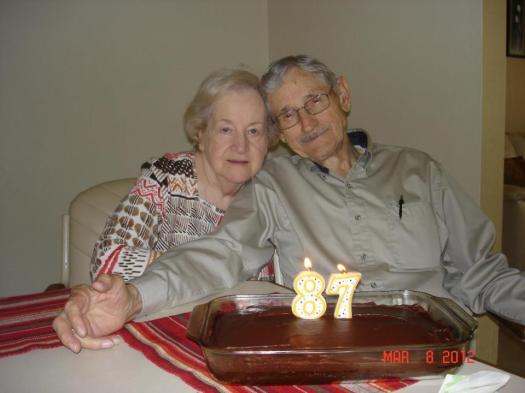
My mom has been diagnosed with Gastric Lymphoma, it appears that the only treatment will be pain management. I would appreciate prayers for her and my dad. They have been married for 66 years. I love you, Mom.

from Guatemala this morning

A team of 28 people from three different churches are serving the children of Guatemala this week. I am privileged to be able to serve as leader of this team. Folks from Twin Rivers Worship Center in St. Louis, Missouri, Ridge Community Church in Dundee, Florida and Cross Community Church in Palm Beach Gardens, Florida make up this team. Member’s ages are from 15 to 50 something.

We are visiting and serving the children of Casa Shalom orphanage in San Lucas, El Amor de Patricia Orphanage in San Lucas as well as a nearby Hospice for children with HIV/AIDS.  We will be pouring concrete, painting walls, installing sofit and anything else we are physically capable of doing. We are loaded with several hundred pounds of new clothing, shoes, blankets and toys. The most important thing we are doing is loving the children. In each of the three locations, kids come from unimaginable conditions. They are now in a safe place and our job is two fold: share the love of Jesus with the children who are there and create conditions that are conducive for more children to be saved from deplorable conditions around the country.

This trip is being coordinated with the assistance of International Orphan Support. If you haven’t heard of or taken a look at what this organization does, please do so at iorphan.cc.

We would appreciate some prayer for the children we are serving, our hosts who work with the children full time and for our team members.

Thank you, everyone.